Product Introduction
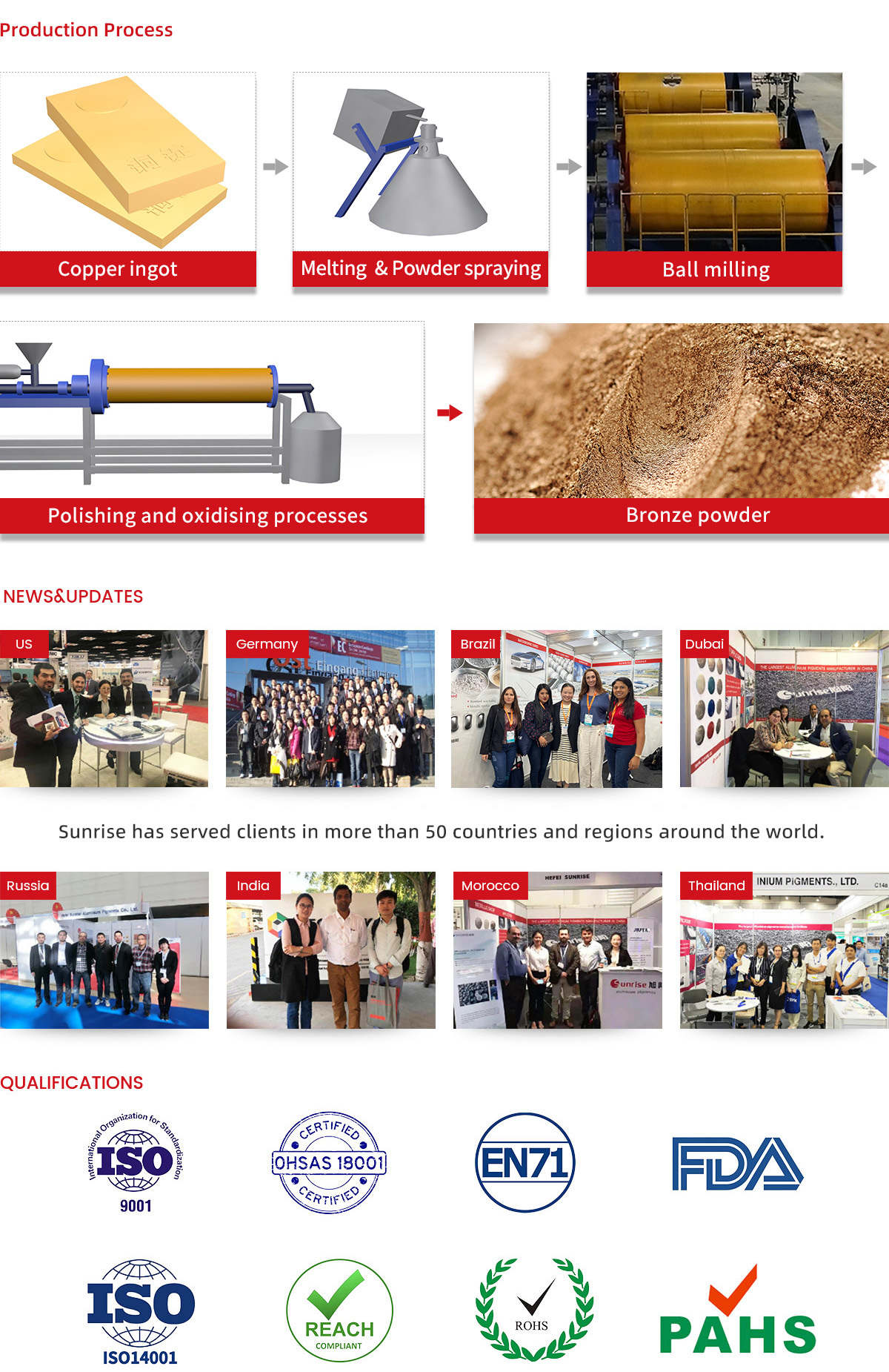
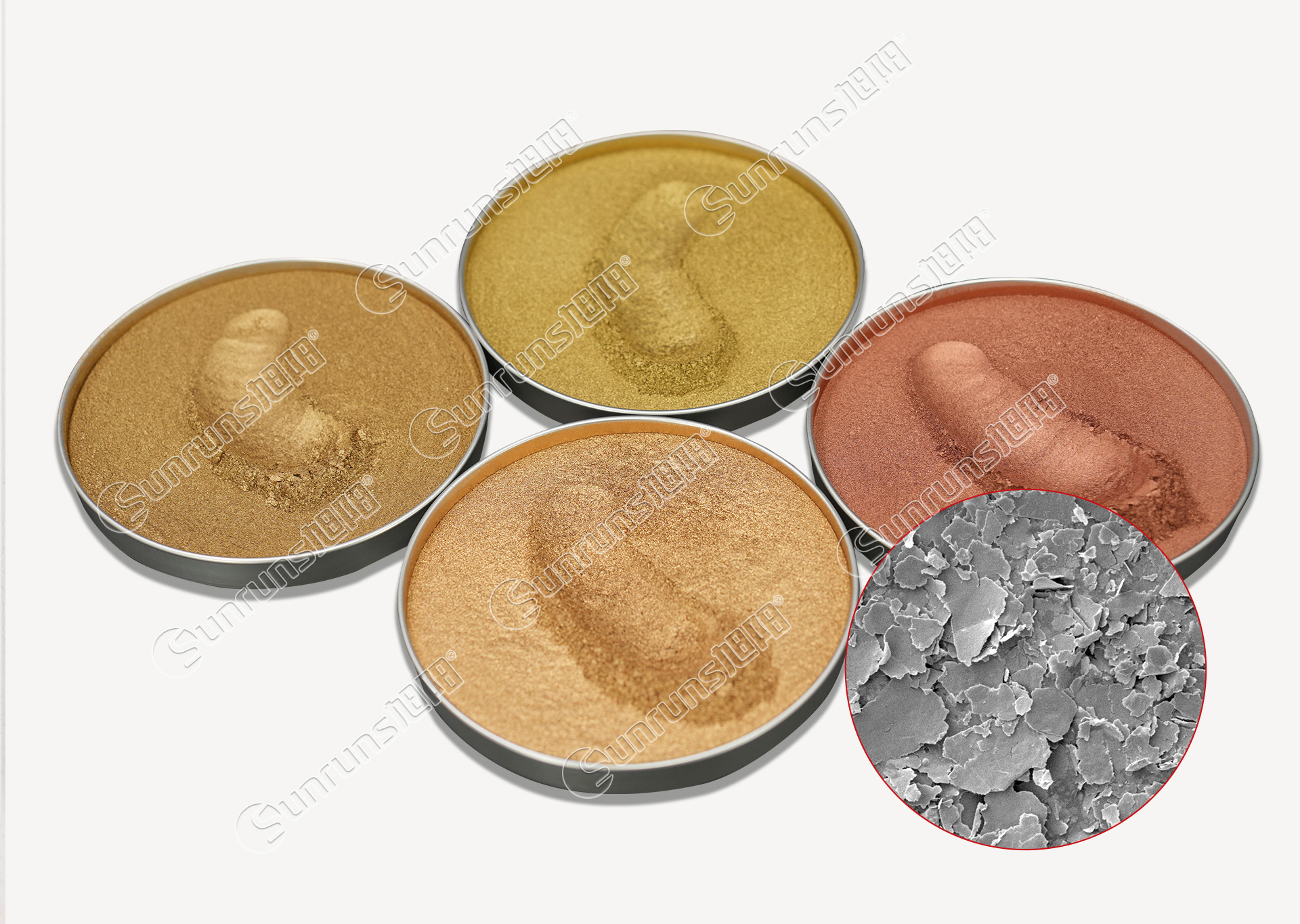
Bronze powder, also known as copper-zinc alloy powder or gold powder, is an extremely fine, flake-like metal powder processed through smelting, powder spraying, ball milling, polishing, and oxidation of copper and zinc as the main raw materials. Copper alloys can exhibit various colors on the surface, including red, golden yellow, white, and even purple, depending on the composition. The color shade of bronze powder varies with the zinc content. When the zinc content is below 10%, it produces a light gold effect, known as pale gold; when it is between 10% and 25%, it produces a rich light gold effect, known as rich pale gold; when it is between 25% and 30%, it produces a rich light gold effect, known as rich gold.
Performance Parameter of Bronze Powder
| Grades | Shades | D-50 Value μm |
Water Coverage cm²/g |
Characteristics | Application |
| 220Mesh | Rich Gold/
Pale Gold/ Rich Pale Gold |
36-40 | 2500-3500 | High Brightness Strong Metallic Effect |  |
| 400Mesh | Rich Gold/
Pale Gold/ Rich Pale Gold |
23-27 | 3500-4500 | High Brightness Strong Metallic Effect | |
| 600Mesh | Rich Gold/
Pale Gold/ Rich Pale Gold |
16-20 | 4000-5000 | High Brightness Strong Metallic Effect | |
| 800Mesh | Rich Gold/
Pale Gold/ Rich Pale Gold |
13-15 | 4500-5500 | High Brightness | |
| 1000Mesh | Rich Gold/
Pale Gold/ Rich Pale Gold |
9-11 | 6000-7000 | Fine High Brightness | |
| 1200Mesh | Rich Gold/
Pale Gold/ Rich Pale Gold |
6-8 | 7000-8000 | High Brightness | |
| 1500Mesh | Rich Gold/
Pale Gold/ Rich Pale Gold |
2-4 | 10000-13000 | High Brightness Good Stability | |
| Gravure Printing
240Mesh |
Rich Gold/
Pale Gold/ Rich Pale Gold |
36-40 | 3000-4000 | High Brightness Strong Metallic Effect | |
| Gravure Printing
400Mesh |
Rich Gold/
Pale Gold/ Rich Pale Gold |
23-27 | 4000-5000 | High Brightness Strong Metallic Effect | |
| Gravure Printing
600Mesh |
Rich Gold/
Pale Gold/ Rich Pale Gold |
16-20 | 4500-5500 | High Brightness Strong Metallic Effect | |
| Gravure Printing
Powder |
Rich Gold/
Pale Gold/ Rich Pale Gold |
6-8 | 8000-10000 | High Brightness Excellent Hiding Good Flake Structure |
 |
| Gravure Printing
Pellets |
Rich Gold/
Pale Gold/ Rich Pale Gold |
6-8 | / | Dust-free Easy to Disperse | |
Precautions
1. Leafing Properties: Ordinary bronze powder typically has good leafing properties, meaning it naturally rises to the surface. It is usually unnecessary to add wetting agents or dispersants, as these can reduce their leafing properties and diminish the metallic effect.
2. Adjusting Leafing Properties: If adjusting the leafing properties of the bronze powder is necessary, adding 0.1-0.5% citric acid can reduce the leafing force. However, this will also decrease the metallic effect.
3. Enhancing Optical Effect: If the desired optical effect is not achieved after adjusting application viscosity and drying time, a small amount of surface lubricant and levelling agent can be added.
4. Redispersibility: Generally, bronze powders exhibit good redispersibility. In case of precipitation, less than 2.0% of anti-settling agents or thixotropic agents, such as bentonite or fumed silica, can be added to the formulation.
5. Storage: Bronze powder and its finished products should be stored at room temperature in a dry environment. Any unused bronze powder should be sealed immediately, as prolonged exposure to air can cause oxidation and deterioration.
6. Resin Compatibility: Avoid using nitrocellulose and epoxy resins, as they can chemically react with copper, forming gelatinous substances. If these resins must be used, they should be applied as quickly as possible.
7. Resin Selection: Select resins with an acid value of less than 3 whenever possible. The lower the acid value of the resin, the better it will perform in the system.
8. Solvent Selection: Aromatic hydrocarbon and ester solvents are recommended for wetting copper gold powder particles completely and achieving thorough dispersion. Avoid using alcohols, ketone solvents, and poorly acidified lipid solvents.
Applications